Why I Stuck with Astro After Comparing WordPress, Ghost, Substack, Brunch and Naver
All I wanted to do was write. But before I knew it, I’d started studying every blogging platform in existence. That bloody perfectionism of mine—not that I ever get anywhere near perfect… Once I decide to do something, I can’t relax until I’ve looked into every little detail.
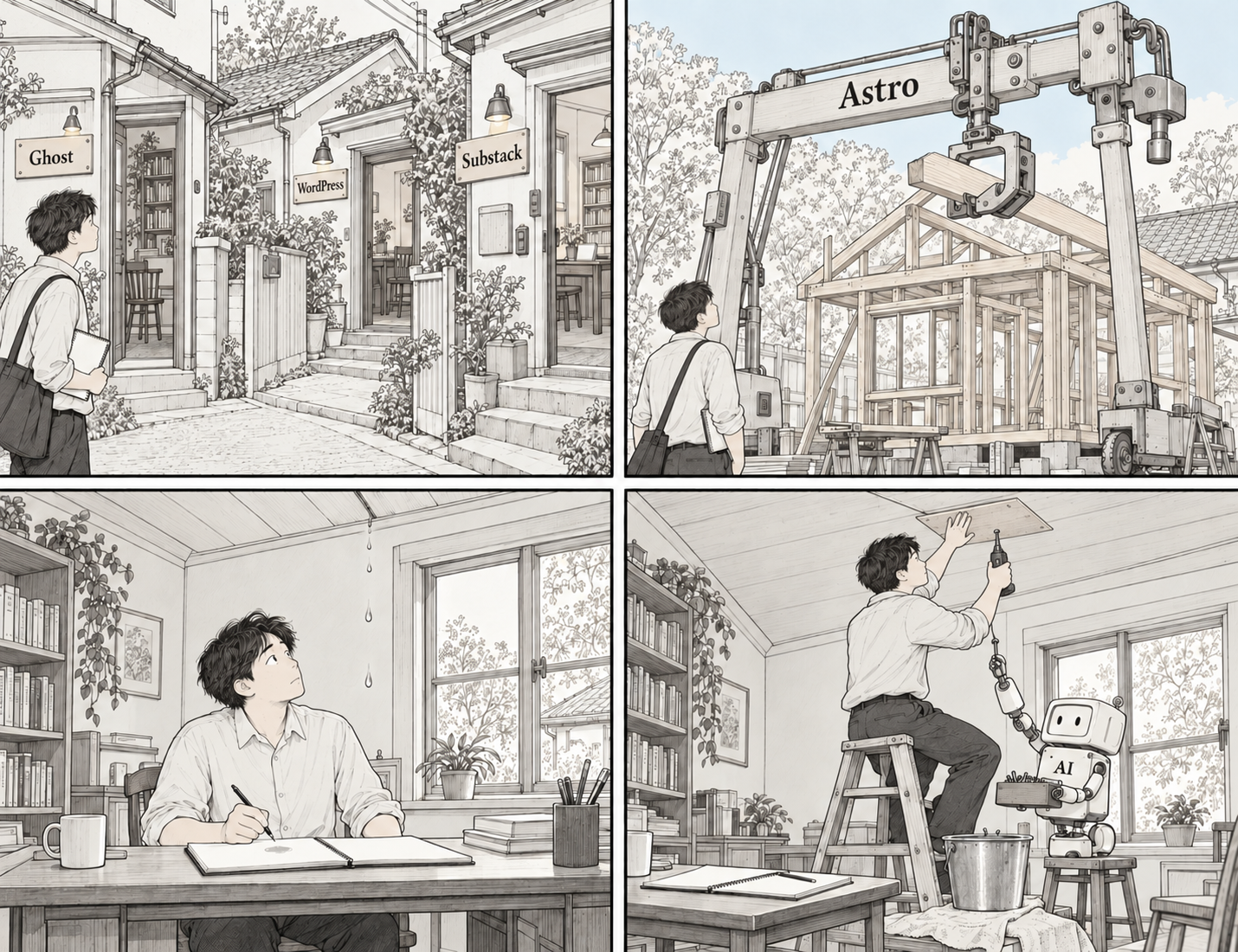
So there I was, visiting other people’s houses, looking around and comparing them, when I came across Astro. Apparently, I could build a home of my own. For someone who’s always wanted something that was truly mine, that was quite the dopamine rush.
Wanting to Write Comfortably in My Own Home
If all I wanted was somewhere to publish, there were already plenty of places to go. Click “Write”, put down my thoughts, hit “Publish”. Done. But alongside that convenience, I wanted the freedom to use the place however I liked, without worrying about what the landlord might think.
It’s not as though I’m trying to write anything particularly grand. Mostly, I want to record what I think and what I’m learning, and share it with other people.
Until now, I’d kept it all tucked away in private, like a diary. But I rarely went back to read any of it, and it always bothered me to see it piling up like rubbish. I thought it might be more interesting to put it out where anyone could read it, and see what other people thought. Their ideas and opinions might even make my own thinking and learning richer.
The place where all of that could begin is ifitallends.com.
Astro Was More About Building a Site Than Giving Me Somewhere to Write
Put simply, Astro is a tool for making web pages. What I write stays as files in a repository. I can keep Korean and English pages separate and change how the writing looks on the screen. GitHub holds those files and their history of changes, while Cloudflare makes the site available on the internet.
As a non-developer, I’d already lost the will to fight by the time I first heard those terms. But I kept slapping my cheeks and pushing through, and slowly, the frost clouding my view began to clear.
They were sharing out different jobs: storing the writing, building the pages, and putting them online. As I began to understand each one a little, I could at least ask where to look if something went wrong.
Of course, it isn’t all convenient. That was something I paid attention to when comparing WordPress, Ghost and Substack: how much of the writing and running of the site could be handled in one place, and how much would I still have to look after myself?
Using Astro doesn’t make my writing better. Keeping my own files doesn’t make readers magically turn up. If an unfamiliar error appears, I have to investigate it. If I change the layout, I have to check that it actually looks right on the live site.
“My own site”—my own home—meant I could do what I liked. It also meant the responsibility was mine.
I Decided to Keep My Own Home and Borrow Space in Other People’s Too
My site already had a place for both Korean and English writing. The article files were there, and the process of getting them online was working. I’m also using Pages CMS to edit my writing and save it to GitHub.
But who would even know my home existed, let alone come and visit?
So I decided to borrow some space in places people were already visiting. I publish the English versions on Substack and Medium, and the Korean versions on Brunch and Naver Blog.
This isn’t a story about why every non-developer should use Astro. If your priority is to publish quickly and spend almost no time maintaining a site, you might choose differently.
But if you don’t like asking the landlord every time you want to put a nail in the wall or keep a pet—and you don’t want to worry about when the terms of the lease might change—then I think this approach could suit you.
In the next piece, I’ll get into the technical problems I’ve run into while building the site with Codex.
I don’t know the first thing about development, yet thanks to AI, here I am doing all sorts of things…
Comments
Sign in with Google to leave a comment.
Loading comments…
No comments yet. You can start the conversation.