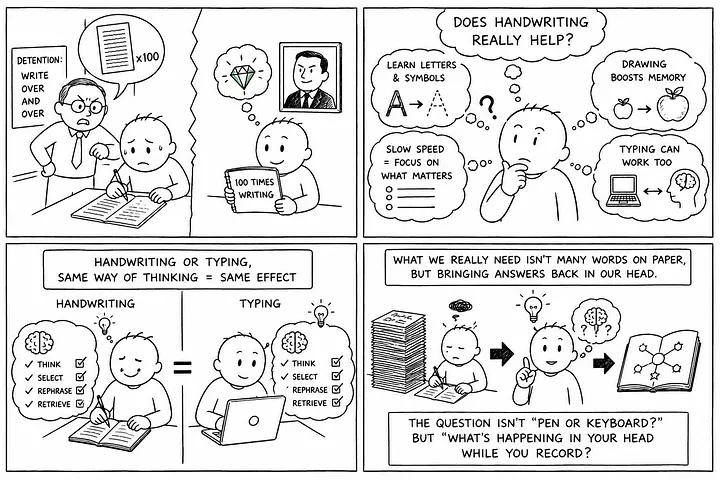
When I was at school in Korea, there was a strange teaching method that was not quite a teaching method. If you got into trouble and had to write a letter of reflection, or if you answered questions incorrectly on a test, you might be told to fill page after page of a notebook by writing the same sentence over and over again. In Korea, we called it kkamji. After writing the same sentence enough times, you stopped seeing the words altogether. Your mind went blank while your hand kept moving.
I thought kkamji would disappear from my life forever once I became an adult. Instead, it came back in more sophisticated forms. One example is Snowfox chairman Kim Seung-ho’s practice of writing down a goal 100 times a day for 100 days. He argues that repeatedly writing what you want makes the goal clearer in your mind and increases the likelihood of eventually turning it into reality. The kkamji I had hated as a child suddenly looked different once it came from the mouth of a successful businessman. So I became curious.
How much does writing by hand actually help us?
What the research says
Writing by hand is a surprisingly complex physical act. Even when writing a single Korean character such as “가,” we are watching the character take shape while simultaneously controlling our hand. We decide which direction to move, where to stop, and how much pressure to apply.
Typing is different. Whether you type “가” or “나,” your fingers are essentially pressing predetermined keys. The relationship between the shape of the character and the movement of your hand is much weaker. This difference appears to matter particularly when we are learning unfamiliar characters or symbols.
Longcamp and her colleagues taught adults unfamiliar characters using either handwriting or keyboard typing. Later, participants had to distinguish the original characters from mirror-reversed versions. Those who had learned them through handwriting were better at remembering their orientation, and the advantage became particularly apparent weeks after training.
Handwriting does not magically improve memory in general. But when what you are learning depends on shape, direction and movement, physically producing it may give the brain additional information to work with.
Something even more interesting has been observed in children. In one study, five-year-old children who could not yet read were asked either to print letters themselves, trace them, or type them on a keyboard. Afterwards, researchers scanned their brains while they looked at those letters. Children who had formed the letters themselves showed stronger recruitment of neural regions associated with reading. What mattered was not whether their handwriting was beautiful. It was the experience of physically controlling their hand and creating the shape themselves, even if the result was crooked and imperfect.
But there is an important limitation here. The study demonstrated differences in brain activation. It did not prove that children who write letters by hand will necessarily become better readers years later.
And if the goal is simply to remember something, drawing may sometimes be even more powerful than writing. In experiments by Wammes and colleagues, participants who drew words later remembered more of them than participants who simply wrote the words down. Drawing ability did not matter. To draw an “apple,” for example, you first have to understand what the word means, decide how to represent it visually, and then physically create that representation. Drawing brings semantic, visual and motor processing together. The researchers called this the drawing effect.
Perhaps the real advantage of handwriting is its inconvenience
Handwriting is slow. If you try to write down every word a lecturer says, you will quickly fall behind. So you are forced to choose.
“What actually matters here?”
Then you have to reduce it further.
“How would I explain this in my own words?”
The inconvenience of handwriting can force us to think. This idea became famous after research suggesting that students taking handwritten notes learned better than students using laptops.
But there is an important twist. When researchers later attempted to replicate the influential findings, they did reproduce one part of the original result: laptop users wrote more words and copied more of the lecture verbatim. What they did not clearly reproduce was a learning advantage for the handwriting group. A small meta-analysis of similar studies found the same pattern. There is no strong evidence that handwriting itself automatically produces better immediate learning.
The problem with kkamji: you can finish it without thinking
When you repeatedly copy the correct answer after getting a test question wrong, you probably think about it for the first few repetitions. Then your hand takes over. Repetition may have some value when the goal is simply to become familiar with a physical form or automate a basic movement. But if the real problem is understanding why you were wrong, mindless copying becomes much less useful.
Writing:
“The correct answer is B.”
one hundred times requires less thinking than covering the answer, attempting the question again, and then asking:
“Why did I think D was correct?”
The second approach forces you to retrieve information from memory and inspect your own reasoning. Learning is not about leaving as many words as possible on a piece of paper. It is about forcing the brain to retrieve, reconstruct and correct what it knows.
That is the real weakness of kkamji. You can complete it without thinking.
So what about writing your goal 100 times?
I do not think repeatedly writing down a goal is necessarily meaningless. Seeing the same goal every day may keep it mentally available. You may notice opportunities or obstacles related to it more often. Writing at the same time every morning may also become a ritual that tells your brain:
“Now it is time to work!”
But there is a dangerous illusion hidden inside the practice. Writing down a goal can create the satisfying feeling that you have already done something towards achieving it. Meanwhile, the uncomfortable actions actually required to make it happen can remain untouched. Writing down a goal and moving towards a goal are completely different behaviours.
So perhaps, if you are going to write your goal, it would be more useful to continue.
“I will double my business revenue within one year.”
Then ask:
“What is the biggest obstacle preventing that from happening?”
And:
“When that obstacle appears, what exactly will I do?”
Psychologists have studied a similar approach known as mental contrasting with implementation intentions, or MCII. Instead of only imagining the future you want, you contrast that future with the obstacles standing in your way and then connect those obstacles to an if–then plan:
“If X happens, I will do Y.”
A meta-analysis covering 21 studies and 15,907 participants found a small-to-moderate positive effect on goal attainment, although the authors also warned that publication bias may mean the true effect is somewhat smaller.
The point is subtle but important. The useful part may not be writing the dream. It may be using writing to confront what stands between the dream and reality.
Writing about your emotions does not automatically heal you either
When I am stressed or emotionally overwhelmed, I write in my journal. And personally, I genuinely feel lighter afterwards. But apparently, that does not happen for everyone. A meta-analysis of 39 randomised controlled trials examining expressive writing among physically healthy adults experiencing different levels of stress found no clear long-term reduction in depressive symptoms.
The effects also appeared to vary depending on factors such as how many writing sessions people completed and what they were asked to write about.
Again, the important question may not be whether you write, but how you write. There is a difference between repeatedly writing:
“Why did this happen to me?”
and stepping slightly outside the experience to ask:
“Why was I so angry at that moment?”
“What did I actually want?”
The physical act is almost identical. The mental act is completely different. Nor does endlessly repeating positive sentences necessarily make us more positive.
In one study, participants repeated the statement:
“I’m a lovable person.”
People with relatively high self-esteem felt slightly better. But participants with low self-esteem actually felt worse. If the statement is too far from the reality a person currently believes, repeating it may simply make the distance between the two more obvious.
My final verdict on handwriting
This is how I now understand the benefits of handwriting.
- It can be particularly useful when learning letters, symbols and other forms where shape and movement matter.
- Because it is slower, it can force us to identify what matters and reconstruct information in our own words.
- Combining words with drawings and spatial organisation can give memory additional cues.
- But when handwriting becomes mindless repetition, as with kkamji, many of those advantages disappear.
In the end, the important distinction may not be between a pen and a keyboard. It may be between copying and thinking. Handwriting does not automatically deepen thought. If all we do is copy information without selecting it, retrieving it, organising it or trying to explain it, the pen cannot help us.
And typing does not automatically make our thinking shallow either. If we control digital distractions, process rather than transcribe what we hear, review our notes afterwards, and choose a method appropriate to what we are trying to learn, a keyboard can be just as useful.
So perhaps we have been asking the wrong question.
Not:
“Is handwriting better than typing?”
But:
“What is happening inside my mind while I am writing?”
Comments
Sign in with Google to leave a comment.
Loading comments…
No comments yet. You can start the conversation.