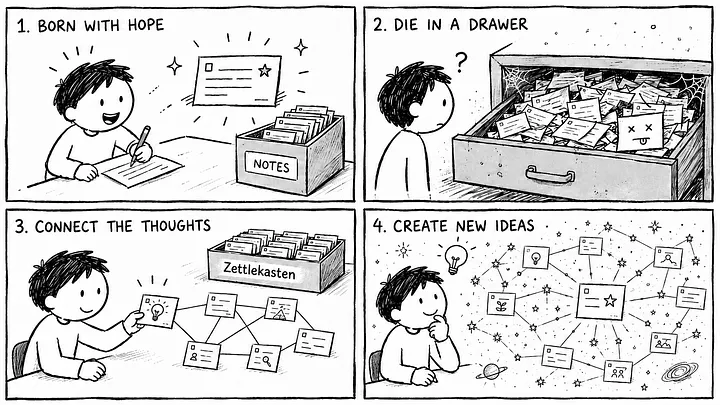
The Birth and Death of a Note
I write down things that come to mind or information that seems like it might be useful later. I use all the fancy language I can manage to create a great-looking note. Before long, I forget where that note is, or even that it exists at all. Then one day, I open the drawer where all those notes have piled up and find it full of rubbish I do not even recognise. Just looking at it is stressful. So I firmly close the drawer, find myself a new one with a fresh mood and renewed determination, and start filling it with rubbish all over again.
This is how the birth and death of most notes ends: forgotten and abandoned. Every time I saw something that had been born with such joy and excitement end up being abandoned so meaninglessly, it bothered me like a splinter stuck in my finger.
I moved from Evernote to Samsung Notes, Notion and countless other note-taking apps until I finally arrived at Obsidian. For the first time, I felt as though I could faintly see an oasis in the distance. Then I came across the concept of Zettelkasten, and that faint oasis became clearer in front of me.
Zettelkasten: Is It Really the Saviour of Notes?
Zettelkasten…
The name alone makes you want to turn around and walk away. It sounds like something you would need a PhD in German philosophy just to install. It turns out that in German it simply means “slip box”. It is a note-taking system where each note becomes an independent thought and is connected with other notes to create new ideas.
I found the thinking of German scholar Niklas Luhmann, who further developed and popularised the concept of Zettelkasten, particularly interesting. We normally think of notes as the result of organising the thoughts already inside our heads into writing. But he explains that writing itself is part of the thinking process. By writing things down, we create understanding and thought.
For example, imagine having two opposing ideas in your head. It is not easy to organise them purely in your mind. This is because whenever the brain retrieves a memory, it reconstructs it, connects unrelated stories, fills in gaps, ignores contradictions and tries to reach a quick conclusion. But once you write those thoughts down, you can create some distance from them and think about them more objectively.
The way he describes taking notes is, in some ways, quite simple. I collect anything I want to save in a Fleeting Note folder without worrying about format (personally, I call this folder “Raw”). Then I organise the author’s main ideas in my own language — not my own thoughts — while keeping the author’s original meaning as much as possible, and move them into Literature Notes. (personally, the name Source Notes makes more sense to me). I think of this purely as a place to check how well I have understood the author’s thoughts. Then, using my own knowledge and experience, I ask questions that the author did not ask, develop new ideas from the author’s thoughts, and save them as Permanent Notes.
At first, I thought Permanent Notes were simply a kind of hyperlink. If I found something interesting or useful in the main text and wanted to study it in more detail, I would create a separate note called a Permanent Note and organise the information there. But the more I studied, the more I realised that I had completely misunderstood it.
People can read the same sentence and interpret it differently. That is because everyone has different knowledge and experiences. Zettelkasten focuses on that difference. Based on our own unique knowledge and experiences, we think differently about the things the author may not have seen, ask different questions, and develop them into new ideas. Among those ideas, only the ones that can continue to be reused in the future are recorded as Permanent Notes. Principles, arguments, distinctions between concepts, questions, ideas developed from observations, counterarguments and conditions can all become Permanent Notes.
There are a few things to keep in mind when writing Permanent Notes.
1. Write in complete sentences, in your own words.
Write them so that your future self can easily understand them without having to look at the original source. Each Permanent Note should contain a complete sentence and a perfectly independent idea, to the point that simply collecting and rearranging Permanent Notes could form a first draft.
2. Always think about how a new note connects with existing notes.
Personally, I think the greatest power of Zettelkasten appears when these notes connect with one another and create a compounding effect. If they are not connected and exist only as independent notes, the result is simply:
1 + 1 = 2.
But when these independent notes are connected with one another, and every new note creates more connections, pulling out just one note can bring out a whole bunch of others with it, like potatoes hanging together by their stems. That is how not just one, but many new ideas are created.
3. Extract an abstract principle from a specific situation to create those connections.
To make these connections, you need to abstract the content of an individual Permanent Note and extract a broader principle from it. For example, if we abstract the specific situation in Romeo and Juliet — two young lovers from two families that are enemies — we can extract the principle that:
Conflict between groups can destroy an individual’s love and choices.
The specific circumstances of Romeo and Juliet exist only within that story, but the abstract principle can connect with other notes.
4. Put a bell around the note’s neck with tags, titles and connected notes.
Use broad concepts for tags, choose a title that clearly shows the abstract principle, and write down why the note is connected to other notes. Most notes are discovered not through search, but through other notes in this way.
Source Notes do not need to be organised in the same way. Simply use the original title and publication information so that you can identify the source. Since the Source Note already contains links to the Permanent Notes, you only need to be able to easily find which Source Note it came from later when you want to check the source of a Permanent Note.
Write What Is Easy to Write Now, and Only What You Want to Write
I also found Luhmann’s way of working interesting. He left behind an enormous amount of work: dozens of books, hundreds of academic papers and roughly 90,000 notes
What is even more surprising is that he did not have a large number of assistants. He explained his high productivity not through extraordinary willpower or genius, but through his way of working and his Zettelkasten. He worked on things that were easy to do right now, things he already knew how to write, or things he was ready to write. And when he got stuck, he did not keep holding on to the same task. He moved on to something else. He did not mistake forcing himself to continue with a blocked task for diligence. Instead, he had real control over his work because he could always choose the subjects he found most interesting and had enough material to write about.
Even difficult work no longer feels as difficult when it aligns with our internal goals and we feel that we have control over the process. But to have that control, we need to be able to accept that new thoughts and information may change our original perspective or even the topic itself during the writing process. We need to be able to enjoy that process. If a more promising idea appears, we should be willing to boldly abandon the first idea. Only with this kind of flexible behaviour and way of thinking can we have real control.
Notes That Create Value for Others, Not Just for Me
Unless it is a diary, I personally do not think notes that I keep only for myself have much meaning. At first, I organise and record things for myself. Then one day, I have a thought.
“Could this be even slightly useful to someone else?”
So I start sharing. The thought that someone else will see it changes my attitude. Just as I think it is basic courtesy to put on at least a little makeup even when Korean women only go to the local supermarket, I start putting more effort into my writing than before. I polish the writing so that other people can understand it more easily, and I look for more material that either supports or challenges the arguments in my writing. Naturally, I end up studying the subject more deeply. Different people give me different feedback on what I have written, making me aware of things I had never even thought about. What began as an attempt to help other people ends up broadening my own thinking, deepening it and sometimes changing it completely.
Maybe the real death of a note is not forgetting it. It is never letting it go anywhere.
Comments
Sign in with Google to leave a comment.
Loading comments…
No comments yet. You can start the conversation.