The author of Rich Dad Poor Dad once put it like this:
“It’s the money, stupid.”
We dress our problems up with all kinds of other explanations and solutions, but in the end, the conclusion is money.
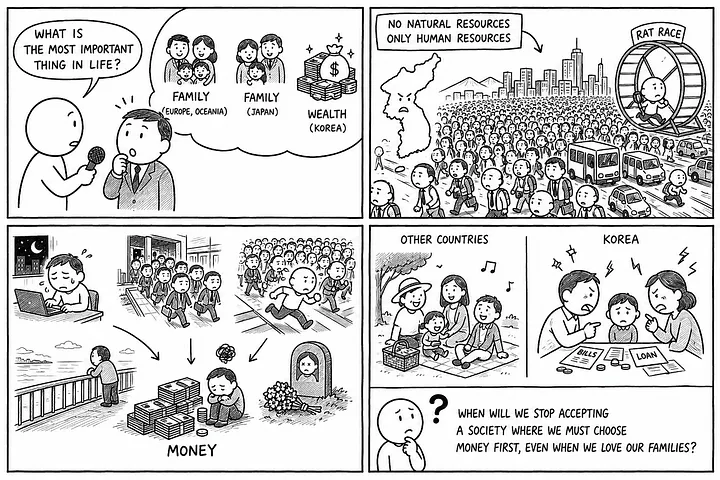
“What is the most important thing in life?”
A survey across 17 advanced economies asked people what made their lives feel meaningful, fulfilling or worthwhile. Across Europe and Oceania, and even in Japan, family came first. South Korea was the only country that gave a completely different answer:
“Wealth.”
As a Korean, I was not particularly surprised. It was almost exactly the answer I had expected. Korea is too unforgiving a land for the warmth of family to take root easily. In a country with few natural resources, its only real resource is its people. On a tiny piece of land roughly one-hundredth the size of the United States, around fifty million people compete fiercely every day simply to make a living. When losing your job can leave you without enough government support and at risk of losing everything, it is not easy to live leisurely while speaking only about the meaning of family.
People work like rats trapped on a wheel, enduring intense labour day after day. They return home and collapse into bed, only to wake again almost immediately and go back to work. In that endless routine, money becomes their only hope and their only visible escape.
When financial insecurity grows, a person’s attention becomes trapped by the problems that must be solved immediately. Psychology explains this through the idea of scarcity: when we do not have enough, the lack itself consumes our mental space. Asking someone who is worried about this month’s rent to reflect on the meaning of family is like asking a drowning person about the purpose of life.
The cars filling every inch of the roads.
The people rushing through crowded streets, weaving around one another like footballers dribbling past defenders.
The office workers pouring out of buildings at lunchtime like chickens bursting from a cage.
Those standing on bridges over the Han River, staring blankly at the sky.
Even those who eventually bring their own lives to an early end.
Almost everything that makes them move, struggle and suffer comes back to money. Most of the anxiety, worry and pain experienced by the people around me seems like something money could solve.
When I say this so openly, some people look at me as though I am shallow and materialistic. I used to do the same. I believed it was wrong to speak as though money were everything. I tried to live in pursuit of something beyond it. But as I grew older and the light called youth slowly began to fade, I realised something. When we are young, youth feels as though it will last forever. We believe that even if we fail, we will always have another chance to begin again. We may not have much money, but we are full of confidence that we can obtain something even more valuable.
“People matter more than money.”
That is also true. But without money, eventually, we cannot protect people either. Friendships are difficult enough. Even families can collapse when money becomes a problem. Conversations with the person you love gradually turn into arguments. The happy hours you once spent together are replaced by labour performed for survival.
After immigrating to Australia, I began to encounter families bound closely together by love much more often. When people experience financial hardship, the government provides at least a basic level of support to help them survive. Surrounded by Australians who seem to live with more ease, I do not feel the same pressure or need to struggle so desperately. I have come to understand just how deeply a person’s environment shapes their values. I had never even thought seriously about having a family. Now I dream of one.
Even so, my belief that money matters has not changed very much.
I want to give the family I love everything they want to eat and everything they want to experience.
I want to travel to different countries with them and create beautiful memories and experiences together.
I want to help them avoid a life in which they suffer because of money or are forced to live in ways they never wanted.
For that, money is still necessary.
In the end, what I want is not money itself. It is the freedom that money gives me.
The freedom not to do work I hate because I need the money.
The freedom not to meet people I dislike because I need the money.
The freedom to spend time with my family.
The question we should really be asking is not:
“Which is more important, money or family?”
It is this:
“How long will we continue to accept as normal a society in which people love their families, yet still feel compelled to answer ‘money’ first?”
Comments
Sign in with Google to leave a comment.
Loading comments…
No comments yet. You can start the conversation.