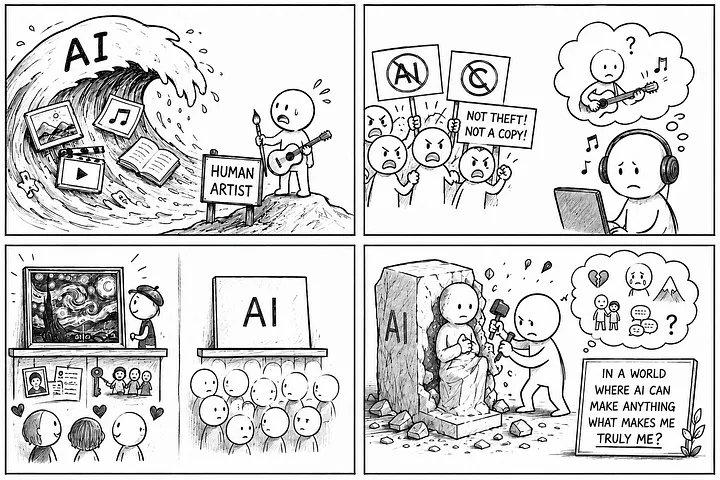
Thanks to AI, anyone can now create images, produce music and videos, and even write novels. Results that once took years of training can now be produced before a cup of coffee has gone cold.
Naturally, artists feel threatened. They are filing lawsuits, arguing that their work was used to train AI without permission and demanding a clear distinction between human creation and AI imitation. At first, I found myself wondering:
“Do they really need to be so afraid and defensive?”
Then one day, I heard a song in a video that immediately caught my attention. I looked it up, curious to know who the singer was, only to discover that it had been created by AI. Strangely, I lost interest almost immediately. I usually save every song I love, but suddenly this one no longer felt worth keeping. It was odd. The melody and lyrics I had liked had not changed. Why should it matter so much who — or what — had created them? My mind could not explain it, but something in me rejected it.
When I think about it, I do not love a song, film or novel solely for the work itself. More than anything, I love the story behind it. Why was it created? What struggles, setbacks and unexpected moments were hidden in the process? Whose life did it touch, and how? Once I know that story, the work gains a depth and significance that are difficult to explain.
It may still be too early to say for certain, but I suspect that other people are also beginning to tire of AI-generated content and will increasingly be drawn towards work made by humans. In a world where anything can be produced with ease, the finished product may matter less than who created it, why they created it and what it cost them to do so.
One thing has become clear: technical skill alone will no longer be enough.
“So how should we respond?”
I believe real creative power will come from the experiences and knowledge that belong to one person alone. What they loved. What they lost. What made them angry. Why they stopped at a moment everyone else passed without noticing. What question they have been unable to let go of their entire life.
AI can describe human grief. But it has never wept bitterly before a father’s cold, lifeless body. It has never felt its chest ache after losing someone it loved. It has never spent a lifetime racing forward, only to lose all sense of meaning and suddenly find itself wandering.
“Does that mean anything created by a human is automatically more valuable than something created by AI?”
No.
Writing that merely imitates other people’s words can feel fake even when a human wrote it. Conversely, if someone uses AI but fills the work with real experience, relentless questions and countless choices and revisions, it becomes difficult to dismiss the result as simply fake. The line between humans and AI is not whether a tool was used. It is whether something genuine remains inside the work.
For someone like me — someone whose mind was always full of ideas but who lacked the technical skill and experience to realise them — AI is an enormous opportunity. There was always something clear inside my head, but my hands could not keep up. I wanted to express something visually, but I could not draw well. I wanted to create videos, but the endless maze of editing programs left me feeling helpless before I had even begun. Between the world in my mind and the world outside stood a high wall called technical skill. Of course, I could have learnt those skills. Unfortunately, I had no passion whatsoever for the process of learning them.
AI has lowered that wall. I can explain what I want to say, and it gives me a draft. I can describe a vague image, and it begins to give that image form. It does more than perform tasks I could not do myself. It also shows me possibilities I had not yet imagined.
Research has found that generative AI can improve people’s creative output, with the greatest benefits often going to those whose creative ability was initially rated lower. But the same research revealed a problem: individual works improved, while the works became more similar to one another. When everyone uses the same brilliant assistant, everyone’s voice begins to get polished in the same direction. AI is very good at lifting below-average work above average. But once above-average work floods the world, above average simply becomes the new average.
That is why competitive advantage in the age of AI will not come from using better AI tools or memorising better prompts. It will come from recognising how the first result AI produces differs from what you actually imagined. From discarding what does not belong, revising what does, and continuing until only your own experience and perspective remain. In other words, what matters is the ability to insist on what is uniquely yours until the very end — like carving a block of stone, bit by bit, until it finally takes the shape you had imagined.
The question left for us is this:
Comments
Sign in with Google to leave a comment.
Loading comments…
No comments yet. You can start the conversation.