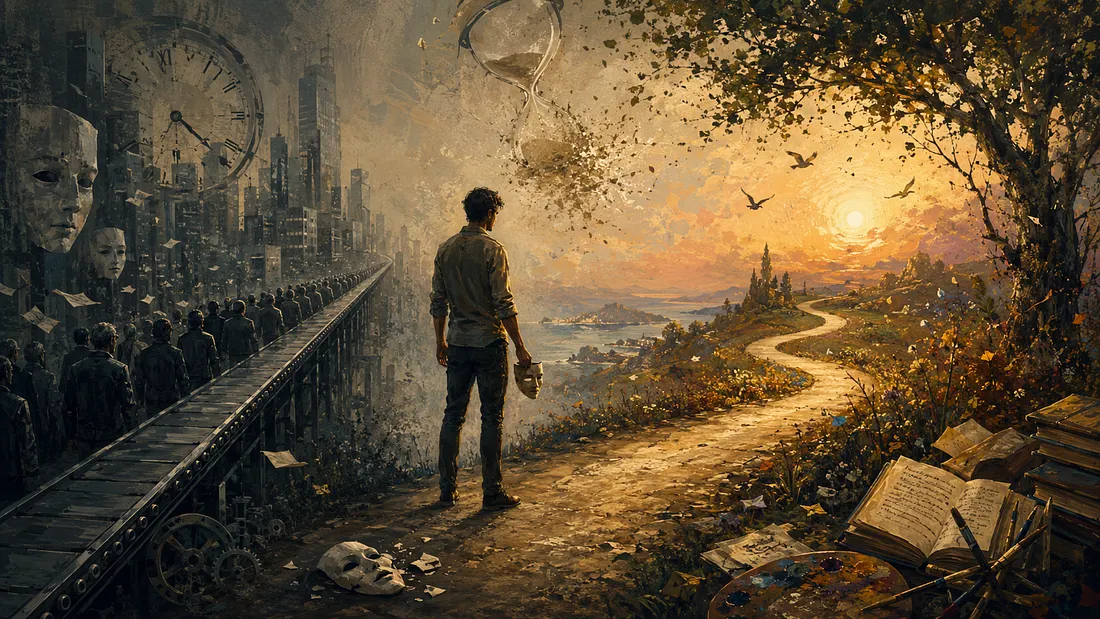
“How long could I keep doing this?”
“Would I be happy living through that time?”
Whenever I have to make a decision, these are the first questions I ask myself. My most important measure has always been sustainability. Not the fastest road, but the one I could keep walking. The same is true of relationships.
“How long could I remain this version of myself in front of this person?”
When we first meet someone, most of us become slightly better people.
We are kinder than usual. More patient. More willing to understand. We overlook things that would normally bother us and soften the parts of ourselves that might be difficult to accept. The beginning of a relationship is often a quiet performance. But when I realise I cannot sustain that performance, I stop. I show the person who I actually am. I do not pretend to be fine when I am not. I do not quietly accept selfishness or disguise disrespect as a difference in personality. What happens next belongs entirely to the other person. They may accept me as I am, or they may slowly move away. Either is fine. If two people were never going to be truly connected, dragging the relationship out only wastes time and gives them more opportunities to hurt each other. Sometimes ending something early is not cruel. It is the most honest kindness available.
I judge work in much the same way. The world is full of roads that promise faster money and quicker results. The real question is whether I could endure walking them for long. A job that pays well but makes every morning feel unbearable. Work that produces results quickly but leaves me unable to understand why any of it matters. I could stay on such a road for a while. But I could never run wholeheartedly along it. And if I cannot stay with something long enough to go deep, the result will probably remain ordinary. The work may be completed, but it will never quite become mine.
Whenever I spoke this way, my mother would say:
“Who works because they enjoy it? You just put up with it.”
After spending enough time in the working world, I realised she was right. That is how most people live. They perform. They endure. They become skilled at swallowing what they feel. Society then admires those who endure the longest and calls them resilient. Someone who leaves a job that conflicts with their values is often seen as immature, incapable of handling real life, or simply a failure. Yet I have never looked at a person who spent an entire life enduring work they hated and thought, What an admirable life. Mostly, I have felt sad. There is something tragic about using your one brief life to prove how much unhappiness you can tolerate.
“If life ends anyway, I want to try what I truly want before it does.”
That has become my motto. Life is too short even if I spend all of it doing only what I love. I am not searching for the thing that will make me successful the fastest. I am searching for something I could still love while failing at it for a long time. That does not mean I want to spend my life drifting between pleasant hobbies. I want to do something I love, but plant my own judgement and way of seeing inside it. I want the work to sharpen my taste. I want to understand why something matters to me, to refine it until it carries a value that could not have come from anyone else.
And one day, I want that private value to become useful to someone beyond me. Useful enough that another person would willingly pay for it. Not because money proves that something is beautiful or meaningful. Plenty of empty things sell well, while remarkable work disappears unnoticed. But money can allow love to continue. It can give a person more time to explore, more freedom to create, and a greater chance of reaching others. It can turn something fragile and private into something sustainable.
So I am not simply searching for work I enjoy. I am searching for something I can love for a long time, and that other people can genuinely value. The place where my joy meets another person’s need. Perhaps the best choice lies somewhere inside that narrow intersection. The difficult part is that many of us already know what we no longer want. We simply cannot let it go.
Because of family.
Because of fear.
Because the familiar misery feels safer than an uncertain life.
But there is one fact we keep treating as though it were distant.
“We are going to die soon.”
And when that moment comes, will we be proud that we endured so well?
Or will we finally admit that what we called patience was fear — and what we called stability was a life we were too frightened to leave?
Comments
Sign in with Google to leave a comment.
Loading comments…
No comments yet. You can start the conversation.