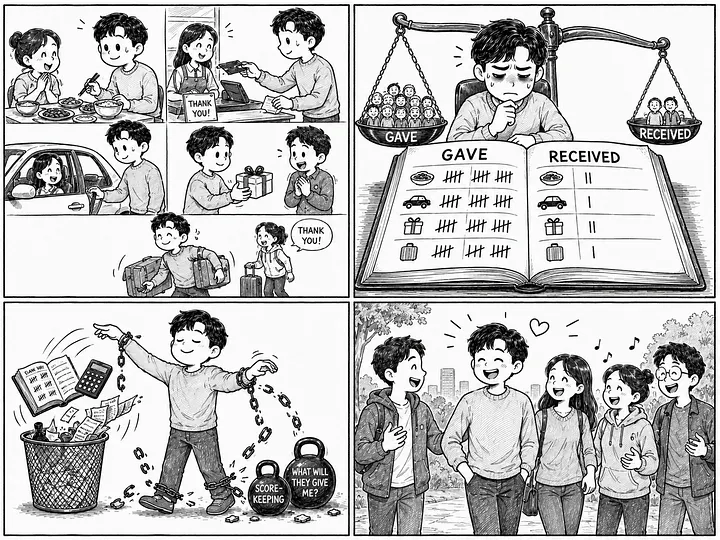
“You have no idea how much more peaceful life becomes when you are willing to lose just a little.”
These were the words of the late Korean actor Lee Soon-jae. He was known as someone who led by example, always choosing to step forward rather than expecting special treatment. Because of the life he lived, his words carried more weight than ordinary advice.
My parents were people who truly lived that way. They helped others even when it meant losing something themselves. But after my father died, the relatives and friends who had once benefited from their generosity seemed to forget everything they had received. When my mother needed them most, they turned away.
That was when I made a promise to myself. I would never live like my parents. I would not allow myself to lose out, even slightly. Whenever I felt I was being treated unfairly, I confronted it, regardless of the other person’s age, status or position. I believed that was fairness. I believed it was justice.
Looking back now, perhaps I did not want fairness as much as I could not bear the humiliation of being the only one who lost. When I was in primary school, someone stole my shoes. Losing them was upsetting, but what hurt even more was the thought that this had happened only to me. I felt singled out. Cheated. For reasons I still do not fully understand, I secretly took my classmate’s shoes and hid them somewhere. I may even have thrown them away. That child had done nothing wrong. But somehow, if someone else suffered the same loss, my own loss felt less unfair. My shoes had not returned. Nothing had been fixed. And yet the fact that I was no longer the only victim made the resentment easier to bear.
Psychology calls this tendency disadvantageous inequality aversion. It means that we are often more sensitive to having less than others than to how much we possess in absolute terms. What matters is not simply what we have, but whether the person beside us appears to have more. This reaction is not necessarily some noble form of moral outrage. It may be closer to an ancient instinct developed to protect our share, our position and our place within a group.
That instinct did not disappear as I grew older. When I bought a car at full price and found even the smallest defect, I pursued compensation for every detail. If I paid for dinner with a friend, I expected them to pay the next time. If they did not, I confronted them directly or quietly stopped seeing them as often.
Family was no exception. On holidays, I counted who had prepared more, who had driven longer and who had washed the dishes one extra time. The moment I felt I was contributing more than everyone else, I stopped. Then I waited. I waited for someone else to notice and step forward.
Even love was not exempt from calculation. If I felt that I loved my partner more than they loved me, I tried to pull back. I reduced my affection until our love seemed roughly equal again. As though love could be balanced like numbers in a ledger.
Psychologists sometimes describe a related tendency as victim sensitivity, a form of justice sensitivity centred on the possibility of being unfairly disadvantaged. It has its strengths. People who are highly sensitive to injustice may recognise exploitation sooner. They may be less easily taken advantage of and more capable of defending their rights. But when that sensitivity becomes too sharp, even small differences can begin to feel like deliberate attacks. A forgotten favour becomes disrespect. An uneven division of work becomes evidence that someone is using us.
A single disappointment becomes part of a larger case we have been quietly building in our minds.
And once that happens, we can become trapped in rumination, anger and the desire to make the other person understand exactly what they have done to us.
Psychologists Daniel Kahneman and Amos Tversky described another closely related tendency as loss aversion. Human beings generally feel the pain of losing something more strongly than the pleasure of gaining something of equal value. The discomfort of having something taken away lingers longer than the happiness of receiving it. That may be why we sometimes pay a much higher price to avoid a very small loss.
We recover the money but lose an entire afternoon.
We win the argument but damage the relationship.
We receive an apology but spend three sleepless nights imagining better replies.
Between people, there will always be giving and receiving. When someone helps us, it is natural to want to return the favour. When we are always the one giving, it is natural to feel hurt. Reciprocity is one of the principles that keeps relationships alive.
The problem begins when we try to divide everything exactly in half, as though we were settling a bill. Life does not divide itself so neatly. Neither do dinner bills, housework, affection or sacrifice.
On some days, I will give more.
On other days, someone else will.
One person may return kindness with money.
Another may return it with time.
Some forms of care come back years later, in a shape we could never have predicted.
But whenever I noticed even the smallest imbalance, I began calculating. And eventually, being with people became exhausting. I was no longer paying attention to the relationship itself. I was paying attention to the difference. When I think about it now, the time and emotion I spent fighting to recover my share were often worth far more than the share itself.
Living with a willingness to lose a little does not mean silently accepting every injustice. It does not mean allowing people to exploit us or abandoning the boundaries that protect us. Perhaps it simply means refusing to interpret every imbalance as an act of unfairness.
It means accepting that I may pay for dinner one extra time.
I may prepare a little more for a family trip
I may give more love on a day when the other person has less to give.
And perhaps I can let those moments pass without turning them into evidence. I am beginning to see that letting go of a small share can sometimes be a way of protecting something far more valuable:
my time, my relationships and the peace inside my own mind.
A person who avoids every possible loss may remain protected. But a person who knows which losses they can afford may be far more free. So when my old calculations begin again, I want to ask myself one question:
What greater thing might I lose while trying to avoid this small loss?
Comments
Sign in with Google to leave a comment.
Loading comments…
No comments yet. You can start the conversation.