“You’re not an easy person.”
I have heard it more times than I can count. And every time, I wonder:
What exactly makes someone easy?
Is it someone who smiles despite wanting to say no?
Someone who swallows their anger to preserve the mood?
Someone who quietly carries the discomfort so no one else has to feel it?
I have very little tolerance for people who lack basic manners. And I rarely let it pass without consequence.
A friend arrives late without even sending a message. I leave and stop answering their calls for a while. Because they showed no respect for my time.
A colleague interrupts me repeatedly with questions while I am working. I answer the first few, then eventually pretend not to hear. Because they are thinking only about their own work, with no respect for mine.
When I was a new employee, senior colleagues kept telling me it was tradition for the newcomer to buy everyone a meal. At first, I ignored them. But when they repeated it every time they saw me, I finally replied: “I’ve only just started. What money do you think I have?” Because there was no respect for the person at the bottom of the hierarchy.
Psychology might describe this as setting boundaries. At the centre of a boundary is not the desire to control another person, but the responsibility to protect oneself. But when I look honestly at my own behaviour, not all of it was boundary-setting. Some of it was retaliation.
Leaving without saying anything.
Ignoring someone as though they did not exist.
Holding everything in, then releasing it all at once with sharpened words.
They did not respect my time, so I stopped responding in order to make them uncomfortable.
They did not respect my work, so I responded by refusing to acknowledge their presence.
I believed I was protecting myself. Sometimes, I was simply punishing them.
There was a senior colleague who was the complete opposite of me. He was gentle and easy-going, and he maintained good relationships with everyone. Even when he was blamed for something he had not done, he never argued back. He simply accepted it. If our manager called him on the weekend to help at his wife’s supermarket, he went. He was not even paid. At work dinners, he never left early. He stayed until the end, taking care of everyone and cleaning up after them. People called him a good person.
People with high agreeableness tend to be attentive to others’ emotions. They are cooperative, considerate and reluctant to create conflict. Unsurprisingly, they are often well liked within groups.
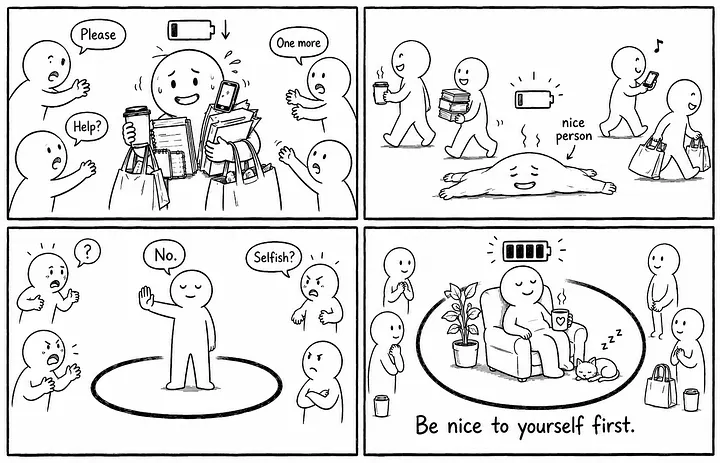
The problem begins when agreeableness becomes entangled with self-sacrifice. They fear that saying no will make people dislike them. They fear that defending themselves will damage the relationship. They fear that expressing discomfort will make them a bad person. So they keep surrendering small pieces of themselves. Other people call it consideration.
But people-pleasing is not always born from kindness. Sometimes it is a survival strategy the body has learned to avoid conflict, rejection and criticism. The problem is that suppressed emotions do not disappear. They slowly begin to consume the person carrying them. They return as exhaustion.
As helplessness. As the strange desire to avoid people for no obvious reason.
One day, that senior colleague came to me and said he could not do it anymore. He was sick of all of it. He thought he needed to take a year off. Then his wife, who worked at the same company, was diagnosed with cancer. She died less than a year later. Perhaps death rearranged the order of everything he had believed mattered. After that, he began to respect himself. And people began calling him difficult. He had merely reclaimed the space within his own life that he had spent years giving away.
I do not impose my standards rigidly from the beginning either. I know that not every discomfort is disrespect. I know that ending every relationship at the first sign of conflict is not strength. A boundary that becomes too rigid does not merely keep harm out. It keeps everyone out. So at first, I try to adjust. I try to understand. I try to be considerate. But the moment someone mistakes that kindness for an entitlement, I make the line visible. You have crossed it.
I do not want to be an “easy person”. Nor do I want to be a “difficult person”. I want to be someone who can say no when the answer is no. Someone who admits when they are wrong. Someone who respects the boundaries of others and expects their own to be respected in return.
In Korean society, a person like that may still be labelled fussy, strange or difficult. I can live with that. I would rather be difficult for others to deal with than become a stranger to myself. Because what is the value of being loved for your kindness if that kindness requires you to abandon the person you are?
Comments
Sign in with Google to leave a comment.
Loading comments…
No comments yet. You can start the conversation.