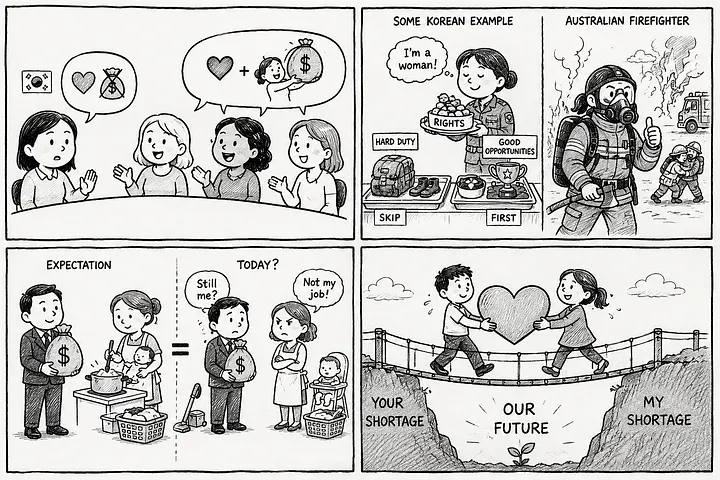
Years ago, I watched a television programme in which women from several countries discussed dating and marriage. The topic was a man they loved who lacked financial security. The Korean panellist said:
“I could date him, but marriage is a different matter.”
She meant that love alone was not enough to marry a man who could not provide financial security. The women from Western countries responded:
“If the person you love does not earn much, why don’t you earn more?”
I was more than a little shocked. The assumptions underlying their views of marriage were completely different. One side saw the husband as the person responsible for supporting the family. The other believed that if two people loved each other, whichever partner was in a better position could shoulder more of the financial responsibility. At the time, I reached a simple conclusion: women’s rights were stronger in the West because women there were more willing to accept the responsibilities that came with those rights.
That belief grew stronger during my time in the Korean Special Forces and as a firefighter. Some of the female soldiers I encountered wanted the same opportunity as men to be soldiers, yet they were excused from night-watch duty and demanding training “because they were women”. At the same time, when special training or promotion offered an advantage to their careers, they were often the first to claim the opportunity — again, “because they were women”.
I saw the same pattern among some female firefighters. Although they preferred office-based roles because they struggled with the physical demands of frontline work, they still expected the same recognition and conditions as those entering dangerous scenes. To them, gender equality seemed like a buffet: pile the rights onto the plate, then put back the responsibilities that do not suit your taste.
Then, in Australia, I saw a crew of firefighters responding to an emergency. They all wore breathing apparatus and moved with calm, practised precision. When the job was over, they removed their equipment one by one. One of them was a woman. She had worn the same equipment as the male firefighters, entered the same scene and performed the same work. It should have been completely ordinary. Yet after what I had grown accustomed to seeing among Korean women, I found it strangely shocking.
Fire and Rescue NSW applies the same minimum physical standard to every applicant, regardless of age or sex. The door is equally open to women, but the threshold is not lowered for them. The test does not divide applicants into men and women. It divides them into those who can perform the work of a firefighter and those who cannot. I could not help thinking of Korean women performing push-ups on their knees during fitness tests.
Basic rights are not a performance bonus awarded to people who carry out their responsibilities well. Women do not acquire human rights by proving that they can carry heavy equipment. Human dignity and equality before the law are not things we earn by demonstrating our abilities. But the right to enter a particular profession cannot easily be separated from the responsibility to perform its essential duties. A fire does not burn less fiercely because the firefighter is a woman. The body of someone waiting to be rescued does not become lighter to match the sex of the rescuer. If a standard is necessary for firefighting, it should be based on the actual demands of the job, not on sex.
Marriage, however, is more complicated than a fireground. It is easy to tell a woman who refuses to marry a man with limited earning power, “Why don’t you earn more?” But within Korean marriages, women still bear more of the burden of pregnancy, child-rearing and unpaid domestic work, as well as a greater risk of career interruption. One study of Korean couples found that wives spent about 3.2 times as much time as their husbands on unpaid housework and caregiving, with the gap widening among couples with children.
A woman who expects to shoulder most of the responsibility for raising children after marriage may not be motivated by greed when she values a husband’s financial stability. It may be a form of insurance against the income and career opportunities she expects to lose.
Korean society has long expected men to provide financially and women to give birth and care for the family. Women received financial protection in exchange for assuming the responsibilities of the home. Men accepted financial responsibility and compulsory military service in exchange for greater authority and freedom.
The problem is that this old bargain is now being rewritten according to individual convenience. Some women want husbands to retain the traditional obligation to provide while expecting housework and childcare to be divided equally. Some men expect their wives to earn an income while continuing to treat housework and childcare as women’s responsibilities. Both sides want to discard whatever disadvantages them while preserving whatever benefits them.
Equality does not mean treating everyone identically regardless of circumstance. Accommodating pregnant women, people with disabilities and parents caring for infants is not a privilege. But when women are given easier standards and more comfortable positions simply because they are women, the state merely reinforces the stereotype that women are weak and must be protected.
Accommodation based on genuine need must be distinguished from preferential treatment based solely on sex. A firefighter must be capable of rescuing people regardless of sex. A soldier must be capable of performing the duties required by the mission.
“If the person you love does not earn much, why don’t you earn more?”
That simple question stayed with me for years. It is true that love alone cannot pay the bills. But if we are not even willing to share the burden of the person we love’s shortcomings, then love itself has no place in reality.
Perhaps love is not about finding someone who lacks nothing. Perhaps it is about carrying one another’s shortcomings together, without turning them into one person’s obligation.
Comments
Sign in with Google to leave a comment.
Loading comments…
No comments yet. You can start the conversation.